
9 Months In: Is Your FM Vendor Still Performing at Day-One Standards?
Nine months into your FM contract, use this 8-question performance scorecard to evaluate whether your facility management vendor is still meeting the standard they promised at signing.

FM contract performance does not usually collapse overnight. It drifts. And by the time most facility directors notice, six months of drift have already happened.
You signed a contract in January. The vendor was sharp during the sales process. The onboarding went reasonably well. The first few months felt solid.
Now it is late September. You are nine months into a contract that was supposed to run like clockwork. And something feels off. Not broken. Not crisis-level. Just off.
That feeling has a name: FM performance drift. And it is one of the most common, most expensive, and most preventable problems in facility management.
This post gives you the tools to find out exactly where your vendor stands before the year ends. Not based on how things feel but based on the specific, documentable evidence of performance that every professional FM contract should produce.
Why FM Performance Drifts and Nobody Talks About It

FM performance drift is not dramatic. It does not announce itself. It shows up in small ways that individually feel like one-off issues but collectively represent a pattern.
A supervisor gets reassigned without notice. An inspection that was supposed to happen weekly starts happening monthly. A complaint that was previously resolved in two hours now takes two days. A coverage gap appears on Monday mornings. Supply levels start running low before anyone catches it.
None of these individually triggers a contract conversation. But together, over six to nine months, they represent a vendor who has deprioritized your site.
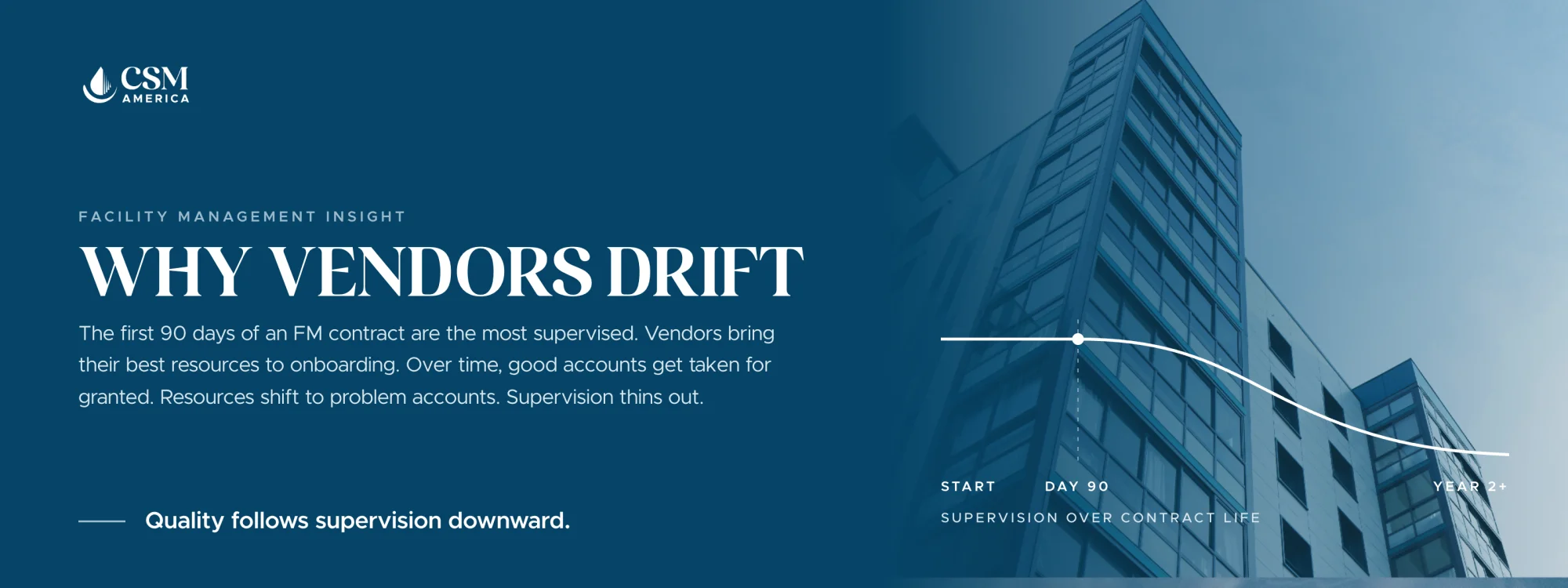
The antidote is not switching vendors every year. It is building documented accountability into the contract and doing a formal performance review before drift becomes damaged.
Nine months in is exactly the right time to do that review.
The 8-Question FM Vendor Performance Scorecard
Use this scorecard to evaluate your current FM vendor's performance right now. Answer honestly. If you are not sure of an answer, that is itself an answer.
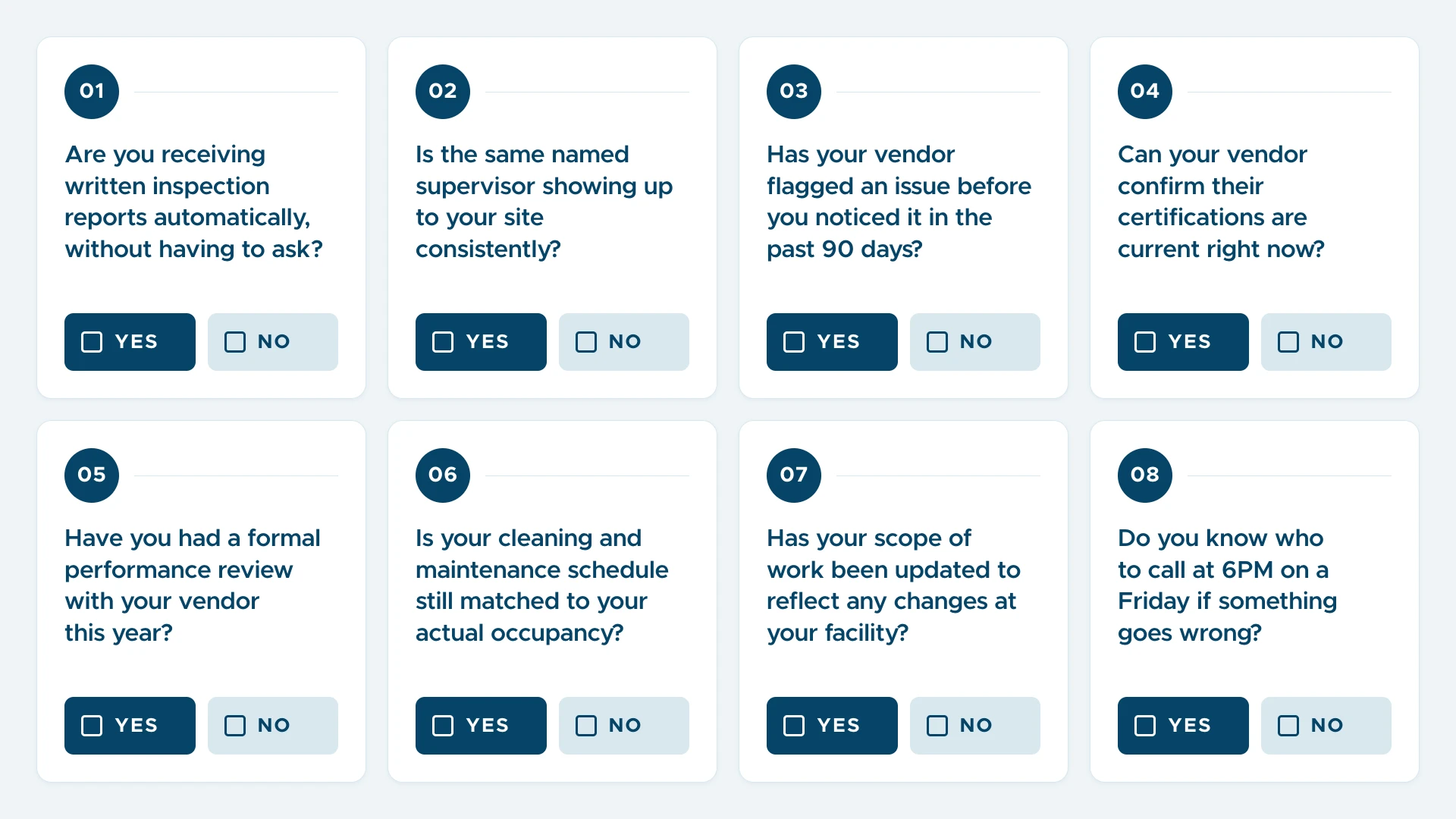
If you answered NO to three or more of these questions, you are not managing a vendor relationship. You are managing a problem that is getting more expensive the longer it goes unaddressed.
If you answered YES to all eight, your FM vendor is performing at a professional standard. Document that and make sure it continues into next year.
What Each "NO" Is Actually Costing You

Each NO on the scorecard is not just a service quality issue. Each one has a direct operational and financial cost.
No written inspection reports
Without documented inspections, you have no record of service delivery, no baseline for quality standards, and no evidence trail if a dispute arises. You are relying entirely on your vendor's word that the work was done correctly. That is not accountability. It is trust without verification.
No consistent named supervisor
A rotating supervisor has no institutional knowledge of your site. They do not know the layout, the equipment, the client's standards, or the history of the account. Every rotation resets the learning curve and resets service quality. In high-security or compliance-sensitive environments, it also resets the credentialing and access verification process.
Vendor has not flagged a single issue proactively
A professional FM partner identifies problems before you do. If your vendor has been on site for nine months and has never once flagged an emerging issue, one of two things is true: either the facility is in perfect condition with no maintenance needs, or your vendor is not looking carefully. One of those is more likely than the other.
Certifications status is unclear
Government, airport, and enterprise contracts often require FM vendors to maintain specific certifications. If you cannot confirm that your vendor's NMSDC, DBE, ACDBE, GDOT, or ALDOT certifications are current right now, that is a compliance risk worth addressing immediately, not at the next renewal cycle.
No formal performance review this year
A performance review is not a complaint session. It is a structured comparison of agreed-upon standards against documented results. If your vendor has not initiated one and you have not requested one, neither party has formally verified whether the contract is being fulfilled. That ambiguity always costs the client more than the vendor.
How to Have the Performance Conversation with Your FM Vendor
If your scorecard reveals problems, the next step is a structured conversation with your vendor. Here is how to approach it.
Request the documentation first. Before the conversation, ask for the last three inspection reports, the current staffing assignment for your site, and a copy of the vendor's current certifications. What they can and cannot produce will tell you more than the meeting itself.
Focus on systems, not incidents. Do not lead with the specific complaint that prompted the conversation. Lead with the question of whether documented systems are in place. Incidents are symptoms. Missing systems are the disease.
Define the correction in writing. If the conversation results in commitments to improve, those commitments should be documented and dated. A verbal promise to do better is not a corrective action plan. A written agreement with specific deliverables and a review date is.
Set a 30-day checkpoint. If your vendor is worth keeping, 30 days is enough time to demonstrate meaningful improvement on any of the eight scorecard questions. If 30 days passes and nothing has changed, you have your answer.
When It Is Time to Find a New FM Partner

Not every underperforming vendor is worth trying to correct. Some performance problems are symptoms of structural issues that cannot be resolved through a meeting.
It is time to look for a new FM partner when:
- Your vendor cannot produce basic documentation of their work on your site.
- Leadership changes at the vendor have resulted in your account being deprioritized.
- The same issues have been raised and committed-to more than once without resolution.
- Your vendor's certifications have lapsed and they did not proactively disclose it.
- Staff turnover on your site has become frequent enough to affect quality consistently.
- Your vendor's response to your performance concerns is defensive rather than solution-oriented.

What to Look for in a Replacement FM Partner
If your scorecard and vendor conversation confirm that a change is needed, the FM vendor evaluation process should focus on five non-negotiable criteria:
- A documented 90-day onboarding plan with named milestones before the contract is signed.
- Site-specific staffing with a named supervisor assigned to your facility.
- Scheduled inspections with written reports delivered automatically on a defined cadence.
- Current, relevant certifications verified through independent third parties.
- A communication protocol that defines response times for urgent and non-urgent issues in writing.
These are not premium features. They are the baseline standard for a professional FM partnership. Any vendor who cannot commit to all five before signing should not be signing.
How CSM America Approaches FM Performance
CSM America has managed facilities for Delta, Hartsfield-Jackson Atlanta International Airport, Truist, Shake Shack, and Fortune 500 headquarters across Georgia since 1994. In that time, we have seen what makes FM partnerships succeed and what makes them fail.
Documented quality assessments: written inspection reports delivered on a scheduled cadence, not on request.
Named, dedicated teams: the same supervisor and crew assigned to your site, not a rotating pool.
Proactive communication: we flag issues before clients notice them, not after they escalate.
Current certifications: NMSDC, DBE, ACDBE, GDOT, and ALDOT — all active, all verifiable.
Customized reporting: clear, concise reports that outline findings and provide actionable recommendations.
If your current vendor is not delivering all five of these consistently, that is not a relationship to manage through another year. It is a problem to solve before your next contract renewal.
Frequently Asked Questions
How often should I formally review my FM vendor's performance?
At minimum, once per year with a formal documented review. For high-traffic or compliance-sensitive environments like healthcare, aviation, or government facilities, a quarterly review is appropriate. The formal review should compare documented performance against the agreed-upon standards in the contract, not just impressions of how things are going.
What should an FM inspection report actually include?
A professional FM inspection report should include the date and time of the inspection, the specific areas inspected, findings for each area, photographic documentation of any issues, corrective actions assigned with responsible parties and due dates, and confirmation of resolution from the prior period's findings. A pass/fail checklist with no detail is not an inspection report.
Is it normal for FM vendors to not share inspection reports proactively?
No. A professional FM partner shares inspection documentation automatically as part of their standard reporting cadence. If your vendor only provides documentation when you ask for it, that is a process gap. If they cannot provide documentation at all, that is a structural problem. Either way it is worth addressing directly.
How long does it take to transition to a new FM vendor?
A professionally managed FM transition takes 30 to 90 days from contract signature to full operational stability. The first 30 days cover site assessment, staffing assignment, and systems setup. Days 30 to 60 focus on service delivery and initial quality inspections. By day 90, a professional FM partner should demonstrate consistent, documentable performance. Transitions that happen in less than 30 days are typically under-planned and carry elevated quality risk in the first quarter.

Stay Updated with Our Insights
Get a tailored solution for your maintenance needs with our expert services.

- Company Info
- About Us
- Careers
- News & Resources
- Support Links
- Contact
- FAQ
- Sitemap
- NAVEX
- Uniform Ordering